Table of Contents
The chapter is split right into 3 sections: (1) types of mental examinations, (2) psychometric buildings of tests, and (3) examination customer certifications and administration of tests. Where feasible an initiative has been made to resolve the context of disability determination; however, the chapter is largely an introduction to emotional screening.
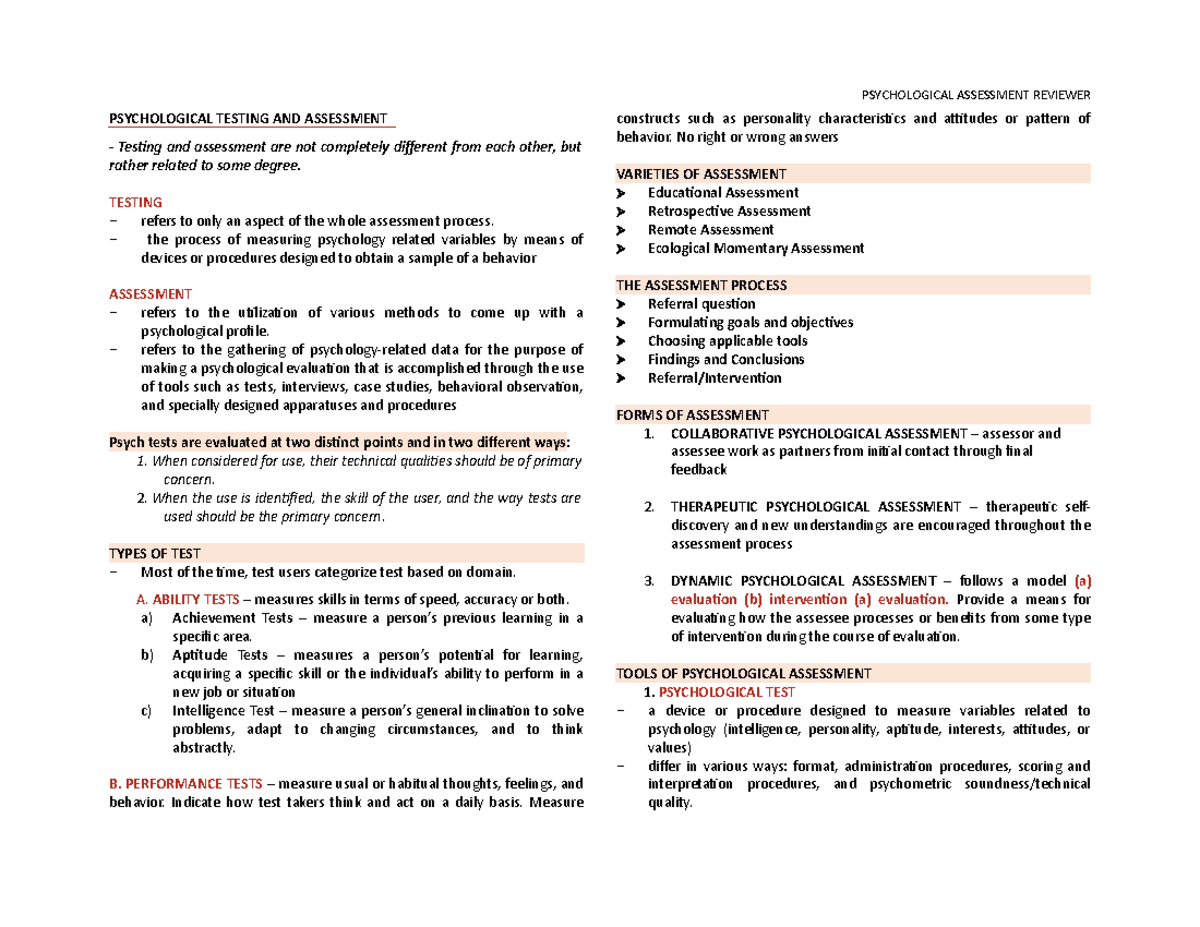
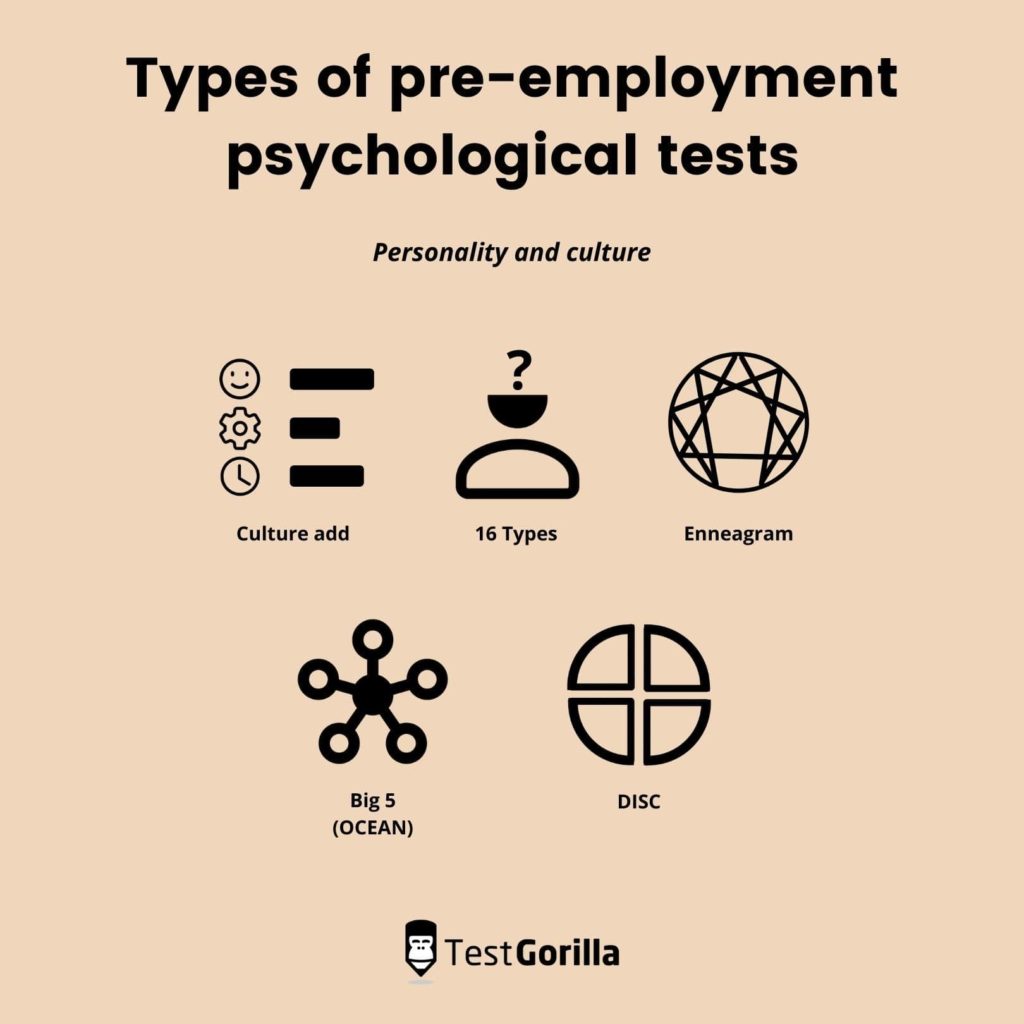
The ensuing conversation lays out several of the distinctions among such tests; however, it is important to note that there is no one appropriate cataloging of the types of examinations because the different classifications usually overlap. Mental tests can be classified by the very nature of the behavior they examine (what they measure), their administration, their racking up, and exactly how they are utilized.
Actions of common actions, such as character, passions, values, and perspectives, might be described as non-cognitive steps. A test of topmost performance, clearly enough, asks people to address questions and solve problems in addition to they perhaps can. Since tests of ultimate efficiency usually entail cognitive efficiency, they are frequently referred to as cognitive examinations.
Non-cognitive procedures seldom have right solutions per se, although in many cases (e.g., work examinations) there may be favored responses; cognitive tests often have things that have correct responses. It is with these 2 lensesnon-cognitive steps and cognitive teststhat the committee analyzes emotional screening for the function of special needs examination in this record.
Psychological Defenses and Parent Guidance Treatment for Understanding
A structured personality action, as an example, might ask people true-or-false concerns regarding whether they involve in various tasks or otherwise. Those are very structured inquiries. On the various other hand, in administering some commonly used individuality measures, the supervisor provides an unstructured projective stimulation such as an inkblot or a picture.
The premise of these projective actions is that when provided with uncertain stimuli a person will forecast his or her underlying and subconscious motivations and attitudes. The racking up of these last actions is often a lot more complex than it is for structured procedures. There is wonderful range in cognitive examinations and what they determine, thus calling for a lengthier explanation.
Both types of tests include discovering. Both sort of tests entail what the test-taker has found out and can do. Accomplishment examinations typically entail finding out from really specialized education and training experiences; whereas, most capacity tests examine finding out that has happened in one's atmosphere. Some facets of learning are plainly both; for instance, vocabulary is discovered in your home, in one's social setting, and in school.
Psychological Defenses within Processing in ADD/ADHD Testing & Evaluations in Chicago
On the other hand, one can likewise have a vocabulary test based on words one finds out just in a scholastic setting. Knowledge tests are so prevalent in numerous professional psychology and neuropsychology circumstances that we also consider them as neuropsychological actions. Some abilities are determined utilizing subtests from intelligence examinations; for instance, particular working memory examinations would certainly be a common example of an intelligence subtest that is used one by one as well.
Some capacity examinations are burglarized spoken and performance examinations. Verbal tests, obviously enough, make use of language to ask questions and show responses. Performance examinations on the various other hand minimize the usage of language; they can include fixing troubles that do not involve language. They might entail manipulating items, mapping puzzles, putting pictures in the proper order, and ending up patterns.
Efficiency examinations are additionally often made use of when the test-taker does not have skills in the language of the testing. Several of these tests evaluate visual spatial tasks.
A truly speeded examination is one that everybody could obtain every concern correct if they had adequate time. Some tests of clerical skills are specifically such as this; they may have two lists of combined numbers, as an example, where some pairings consist of 2 similar numbers and other pairings are different. The test-taker just circles around the pairings that equal.
Working Through Loss through Dynamic Psychotherapy for Parent Guidance
A true power examination is one where all test-takers have sufficient time to do their ideal; the only question is what they can do. Undoubtedly, couple of tests are either simply sped up or purely power tests.
When test-takers have handicaps that impact their ability to reply to questions rapidly, some procedures offer extra time, depending upon their function and the nature of the attributes being assessed. Concerns on both success and capacity tests can involve either recognition or free-response in answering. In instructional and intelligence examinations, recognition examinations typically consist of multiple-choice concerns where one can look for the correct solution among the options, acknowledge it as correct, and choose it as the right solution.

Navigation
Latest Posts
Clinical Training in Psychodynamic Practice in Chicago
Strategies for Regulating Triggers Between Conflicts Learned in Therapy
The Treatment Experience: Timeline